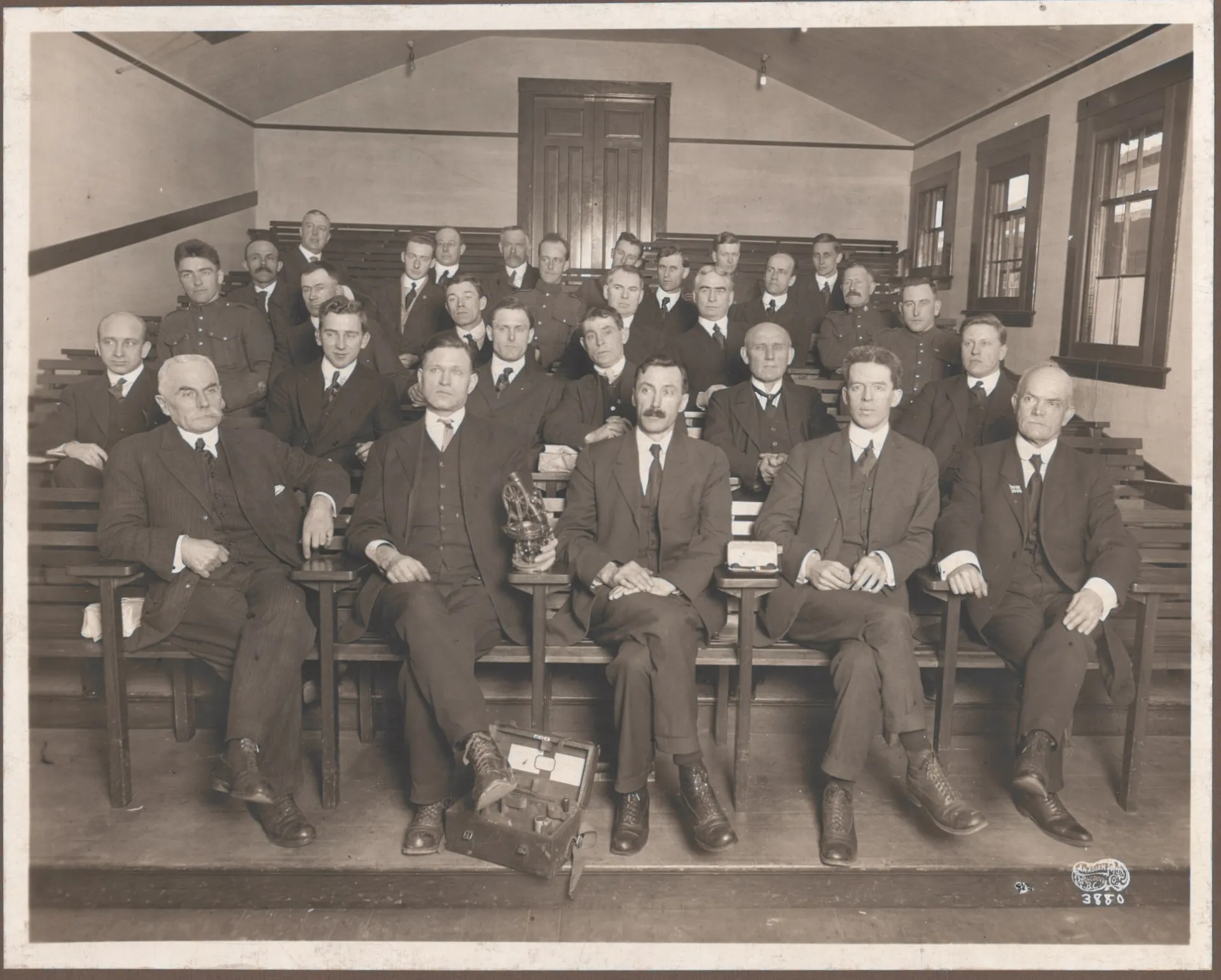
The Department of Mining Engineering was established in 1915, making it one of the earliest academic units at the University of British Columbia. Its creation was part of UBC’s broader vision to prepare highly skilled professionals for the province’s cornerstone resource industries: Agriculture, Fisheries, Forestry, and Mining. At the time, British Columbia was rapidly developing its natural resources to support economic growth, and there was a pressing need for locally trained engineers who understood the province’s unique geology, mining challenges, and community contexts.
Mining was not only a vital economic driver but also a symbol of British Columbia’s frontier spirit—connecting remote communities, attracting international investment, and fueling innovation in engineering and technology. From the outset, the department aimed to provide both rigorous technical training and a deep understanding of the environmental and social dimensions of mining, setting a precedent for the integrated, interdisciplinary approach that continues to define the Institute today.
It was in this context that M. “Jake” Turnbull, instrumental in launching the historic Sullivan Mine in Kimberley in 1908, was appointed as the department’s first professor and head. His leadership laid the foundation for what would become a globally recognized centre for mining education and research.
John M. Turnbull

Born in Montreal in 1877, Turnbull graduated in mining engineering from McGill University in 1897. His early career took him across British Columbia, from the Lanark Mine near Revelstoke to various mining ventures. In 1915, he visited Vancouver to advise UBC’s President and the Dean of Applied Science, Reginald Brock, on teaching mining. During this visit, he became UBC’s second full professor and began a 30-year career at the University, including a term as Acting Dean of Applied Science in 1936.
Today, the Norman B. Keevil Institute of Mining Engineering builds on this rich legacy—offering an innovative, industry-responsive, and internationally recognized program that prepares graduates to make a positive impact wherever their careers take them.
Norman B. Keevil

Dr Keevil is a graduate of the University of Toronto (B.A.Sc. Applied Geology) and the University of California at Berkeley (Ph.D. Geophysics). He received an honorary LL.D from the University of British Columbia in May 1993. He was Vice President Exploration at Teck Corporation from 1962 to 1968, Executive Vice President from 1968 to 1981, President and Chief Executive Officer from 1981 to 2001 and Chairman of the Board from 2001 – 2018. Through his leadership, Teck grew from a small gold mine in Northern Ontario to Canada’s largest diversified resource company with mines in Canada, the United States, Chile and Peru.
Dr Keevil is an avid supporter of research and education in mineral resources at UBC. In 2006, Teck donated $7.5 million toward the establishment of the Norman B. Keevil Institute of Mining Engineering.
Dr Keevil is a lifetime director of the Mining Association of Canada. Dr. Keevil was inducted into the Canadian Mining Hall of Fame in January 2004 and the Canadian Business Hall of Fame in 2012.
You can read more about his life and career in his autobiography, “Never Rest on Your Ores”. The stories about his early days doing geological and geophysical exploration in Ontario and Quebec give a real sense of the fun and challenge of finding an orebody and developing a mine.