Electrical sensing zone technology measures changes in electrical resistance as individual particles pass through an aperture.
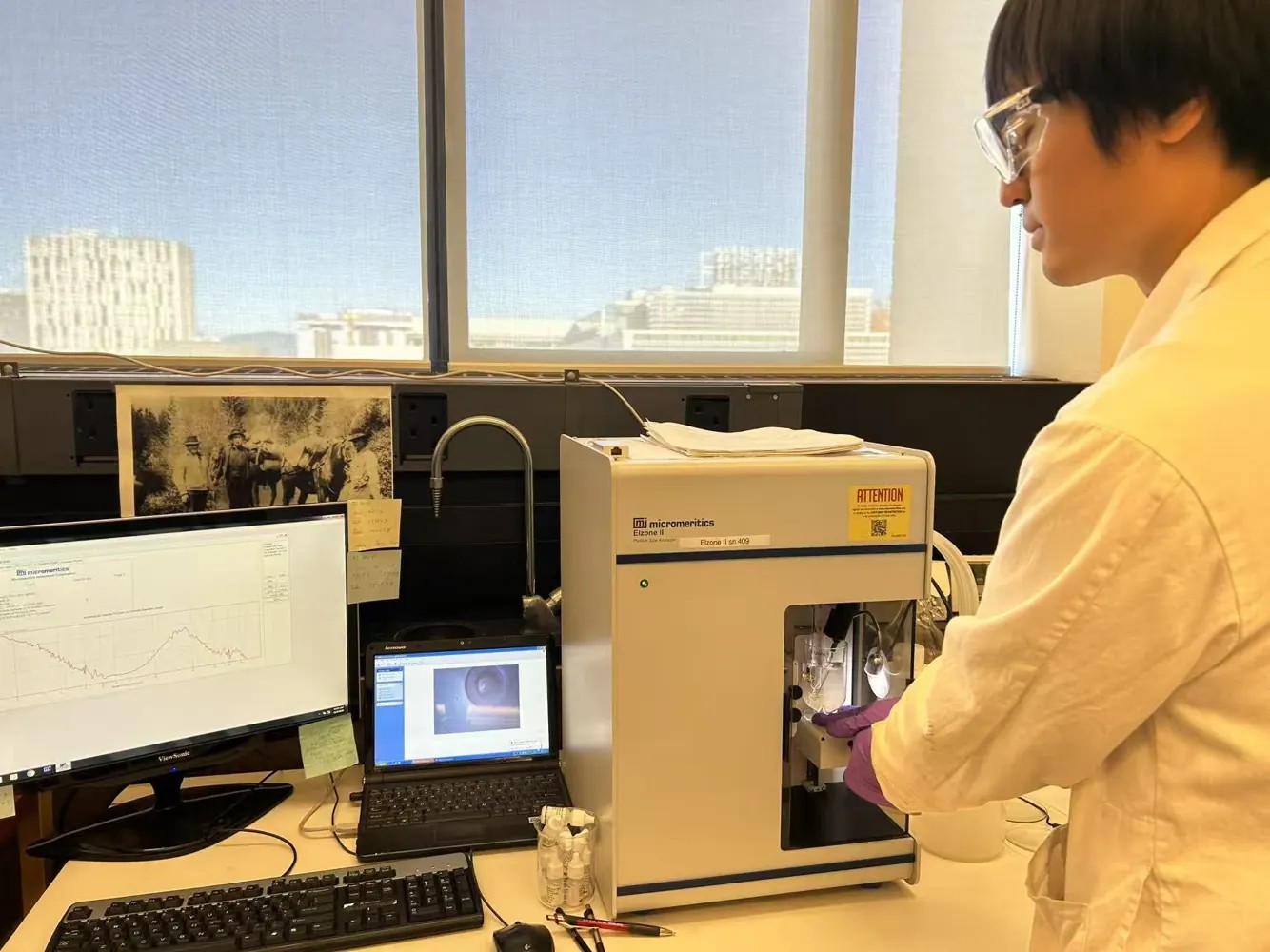
Actual Elzone II in use.
About the technique
Electrical Sensing Zone (ESZ), also known as the Coulter principle, measures particle size and count by detecting changes in electrical resistance as individual particles pass through a small aperture in an electrolyte solution. Particle size is determined by the volume of electrolyte displaced, making the measurement largely independent of particle color, density, and optical properties.
A key advantage of ESZ is its ability to measure particles individually, providing accurate particle size distributions and particle counts. Its high sensitivity to small populations of oversized or undersized particles makes it particularly valuable for quality control, mineral processing, and materials characterization where precise particle sizing and counting are essential.

Schematic of the electrical sensing zone principle. Particles pass individually through a precision orifice, generating electrical pulses related to their volume.
Available instrument

INSTRUMENT PROFILE
Micromeritics Elzone II
Explore particle counting and sizing, sample considerations and photographs